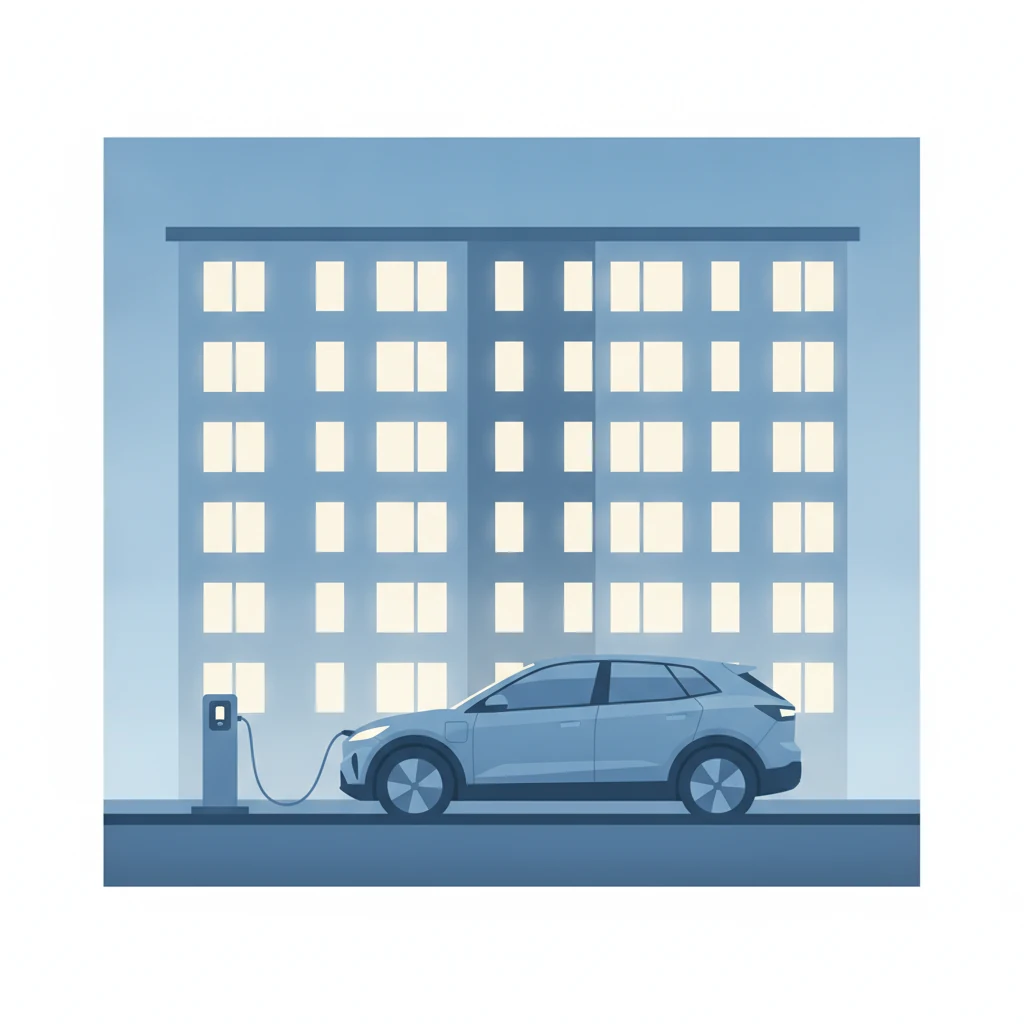
You can absolutely own an electric car without a garage, a driveway, or a charger of your own. People do it every day. The harder question — the one most "apartment EV charging" guides skip — is whether it still saves you money. And the honest answer is that it depends almost entirely on where you plug in, not on which EV you buy.
Here's the thing the cheap-fuel story leaves out: the EV cost advantage is mostly a home-charging advantage. Roughly 80% of U.S. EV charging happens at home overnight, at residential electricity rates (DOE/NREL estimates). That's the cheap energy that makes "EVs cost pennies per mile" true. Take it away and the math gets a lot more interesting.
The hidden engine: cheap home electricity
A typical EV uses about 27 kWh to go 100 miles. The U.S. average residential electricity rate is around 16¢/kWh (EIA). So charging at home costs roughly $0.04 per mile — about a third of what a 30-MPG gas car burns at $4.10/gallon. That gap is the whole reason EVs look cheap to run.
Public charging plays by different rules. Public Level 2 (the slower 240-volt stations) commonly runs $0.20–$0.30/kWh. Public DC fast charging — the kind a no-home-charger driver leans on — typically costs $0.35–$0.60/kWh across the major networks (Electrify America, EVgo, ChargePoint). At those rates the cheap-fuel advantage doesn't just shrink. It can disappear.
Cost per mile, by where you charge
Same EV (27 kWh/100 mi), same $4.10/gallon gas, different plug. This is what a mile actually costs:
| How you fuel | Rate | Cost / mile |
|---|---|---|
| EV — home Level 2 | $0.16/kWh | $0.043 |
| EV — public Level 2 | $0.30/kWh | $0.081 |
| Efficient hybrid (45 MPG) | $4.10/gal | $0.091 |
| EV — public DC fast | $0.45/kWh | $0.122 |
| Gas car (30 MPG) | $4.10/gal | $0.137 |
Read that table top to bottom and the story flips as you go. The EV that charges at home is untouchable at four cents a mile. The EV that lives on DC fast charging is more expensive to fuel than a 45-MPG hybrid — and only barely cheaper than a plain 30-MPG gas car. The car didn't change. The plug did.
Without home charging, "EV vs gas" stops being a question about the vehicle and becomes a question about your charging access.
And public charging has a hidden tax
The per-kWh rate isn't the whole bill. Most fast-charging networks add idle fees — typically $0.40–$0.99 per minute once your car finishes and you haven't unplugged it. Linger 20 minutes past full because you're at dinner and that's $8–$20 tacked onto a single session. Some networks also charge session-initiation fees. Pay-as-you-go pricing is the most expensive tier; network memberships (e.g. Electrify America Pass+, EVgo Plus) cut the per-kWh rate if you charge often enough to justify the subscription. None of that touches the home charger sitting in someone else's garage at 16¢/kWh.
What flips it back toward savings: the mix
Almost nobody charges 100% on DC fast power — that's the worst case, not the typical one. The real lever for a renter is the charging mix. Here's what a month of 1,000 miles costs under three realistic patterns:
| Renter charging pattern | Blended cost / mi | Cost / 1,000 mi |
|---|---|---|
| Free workplace L2 (60%) + DC fast (40%) | $0.049 | $49 |
| Public L2 (70%) + DC fast (30%) | $0.093 | $93 |
| DC fast only (100%) | $0.122 | $122 |
| For comparison: 45-MPG hybrid | $0.091 | $91 |
One variable does most of the work: do you have free or cheap Level 2 somewhere you park anyway — a workplace, a gym, an apartment lot? A driver who tops up on free workplace charging and only fast-charges on road trips beats every gas and hybrid option by a wide margin. A driver with no such access, fast-charging exclusively, is paying more per mile than a Prius. Same apartment, same car — different answer. (For the cases where a thrifty hybrid simply wins, we broke down when hybrids beat EVs on cost across three real comparisons.)
The other side of the ledger: maintenance
Fuel isn't the only running cost, and ignoring the rest would make this a less-than-honest comparison. Even when public charging erodes the fuel advantage, EVs hold a real edge on upkeep: no oil changes, far fewer moving parts, and regenerative braking that spares the brake pads. EV maintenance runs about $0.046 per mile versus roughly $0.092 for a gas car — about half, or near $4,600 saved over 100,000 miles (see our breakdown of EV maintenance costs vs gas). That ~$0.04–$0.05/mile maintenance gap can soften — or fully reverse — a fuel-cost disadvantage. So a fast-charge-only EV that loses to a hybrid on fuel can still come out ahead on total running cost. The fuel table is the scary headline; maintenance is the quiet rebate.
How to find your real number
Before you write off — or romanticize — apartment EV ownership, get three facts about your own situation:
- Can you get Level 2 where you park? Many states now have "right to charge" laws (California, Colorado, Florida, Oregon, and New York among them) that limit how much a landlord or HOA can block an EV charger install. Ask your building. A shared L2 in the lot changes everything.
- What do your local public stations actually charge? Rates swing widely by network and metro. Map the L2 and DC fast options within your normal radius and note the per-kWh price — not the advertised one, the one you'll really pay including any idle fees.
- How many miles do you drive? Low-mileage city drivers feel public-charging premiums far less than long commuters. Fewer miles means a smaller fuel bill either way, which makes convenience matter more than the per-mile rate.
Then run the numbers against your real mix. Our EV vs gas cost calculator has a "share charged at home" slider — drag it down to 0–20% to model life without a home charger, set your public-charging rate, and it auto-fills gas and electricity prices for your state so the comparison reflects where you actually live. If you want the per-mile view directly, the cost-per-mile tool does the same math one mile at a time.
Set the home-charging slider to your reality and see if an EV still pencils out.
Run the calculator →The bottom line
Yes, you can own an EV in an apartment. Whether it saves you money is decided before you ever pick a car — by whether you can plug in somewhere cheap on a regular basis. Land a free workplace charger or a shared L2 in your lot and an EV is still the cheapest thing on the road. Live entirely on pay-as-you-go DC fast charging and a 45-MPG hybrid will quietly cost you less to fuel, even if the EV claws some of it back on maintenance. The question was never really about the car.
Frequently asked questions
Is charging at a public station cheaper than buying gas?
Often, but not always. Public Level 2 (~$0.30/kWh) beats a 30-MPG gas car comfortably. Public DC fast charging (~$0.45/kWh and up, plus possible idle fees) lands close to gas and can cost more than an efficient hybrid. It depends on the station type and your car's efficiency.
Can you charge an EV with no driveway or garage?
Yes — using public Level 2 and DC fast chargers, workplace charging, or a shared charger in an apartment lot. The trade-off isn't whether it's possible; it's cost and convenience. Without cheap regular charging, the EV's running-cost advantage narrows.
How much does it cost to charge an EV per month without home charging?
At 1,000 miles a month, expect roughly $49 if you lean on free workplace charging, around $93 on a public-L2-heavy mix, and up to about $122 if you only DC fast charge — versus about $91 to fuel a 45-MPG hybrid. Your charging mix sets the number.
Do you need a home Level 2 charger for an EV to be worth it?
Not strictly — but cheap, regular charging access is what makes an EV clearly cheaper to run. A home charger is the easiest way to get it; a free workplace charger or a shared apartment-lot L2 can do the same job. Pure pay-as-you-go fast charging is where the savings get thin.