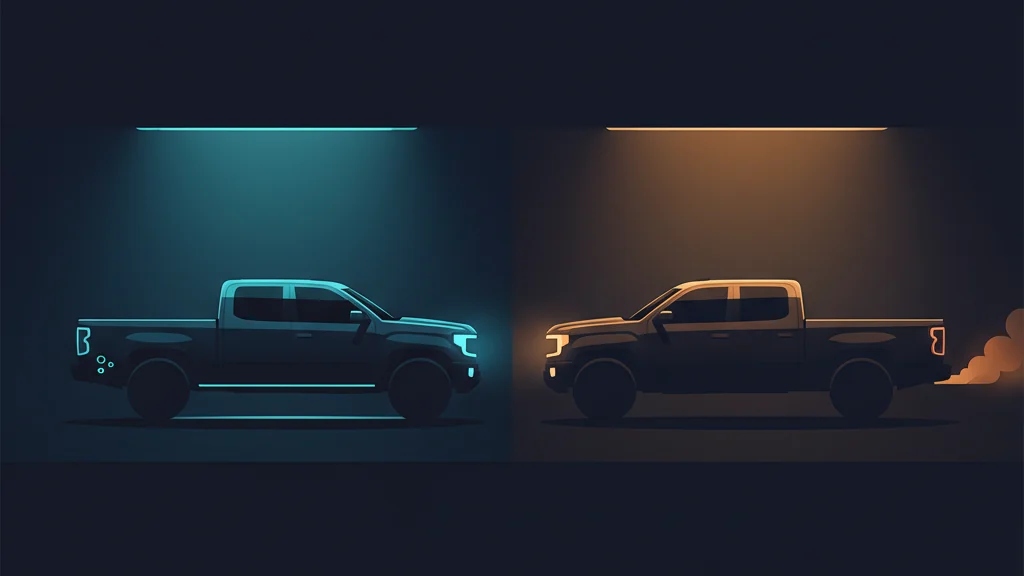
The Ford F-150 has been America's best-selling vehicle for over 40 years. The F-150 Lightning is Ford's attempt to electrify it. Same nameplate, same general shape, completely different powertrain. The Lightning costs about $9,500 more at the dealer. So the question truck buyers are actually asking is simple: does the electric version save enough on gas and maintenance to justify the higher sticker price?
Trucks are where this question gets interesting. A gas F-150 gets 21 MPG. That is not a typo. Truck owners spend roughly twice as much on fuel as sedan owners, which means the potential savings from going electric are significantly larger. We ran the numbers using real 2026 data, and the results surprised us. Here is the full breakdown.
The Two Trucks at a Glance
We are comparing the 2025 Ford F-150 Lightning XLT (standard range battery) and the 2025 Ford F-150 XLT (2.7L EcoBoost V6). Both are the XLT trim, which is the most popular configuration for each, making this the fairest comparison.
- F-150 Lightning XLT: MSRP $52,995 / 48 kWh per 100 miles (EPA) / 240-mile range
- F-150 XLT (2.7L V6): MSRP $43,495 / 21 MPG combined (EPA)
The price gap at purchase is $9,500. That is the hill the Lightning needs to climb through lower operating costs. Notably, this is almost identical to the gap between a Tesla Model 3 and a Toyota Camry, but the fuel math works out very differently for trucks.
Cost Category Breakdown
1. Purchase Price
The gas F-150 XLT starts at $43,495. The Lightning XLT starts at $52,995. The federal EV tax credit (up to $7,500) expired on September 30, 2025, so new buyers in 2026 cannot count on that. State incentives still exist in a handful of places for general buyers — Massachusetts ($3,500 MOR-EV), Rhode Island ($3,000 DRIVE EV), New York (up to $2,000 Drive Clean), New Jersey ($1,500 Charge Up base), and Colorado ($750 base IMVC) — though most exclude trucks above a $55K MSRP cap, which the Lightning approaches. For this baseline comparison, we are using full MSRP with no incentives.
It is worth noting that Ford has been aggressive with Lightning pricing. The truck launched at $39,974 in 2022, jumped to over $55,000 in 2023, then came back down. The $52,995 XLT price is competitive but still a meaningful premium over the gas version.
2. Fuel Costs
This is where trucks make the EV case better than any other vehicle category. A gas F-150 at 21 MPG burns through fuel fast. Using national averages of $0.16/kWh for electricity and $3.20/gallon for gas:
- F-150 Lightning: 48 kWh per 100 miles at $0.16/kWh = $0.077 per mile
- F-150 XLT: 1 gallon per 21 miles at $3.20/gallon = $0.152 per mile
The gas truck costs nearly double per mile to fuel. At 12,000 miles per year, that works out to roughly $1,140/year for the Lightning and $1,829/year for the gas F-150. Over five years, the Lightning saves about $3,443 in fuel costs. This assumes 80% home charging and 20% public fast charging at $0.35/kWh for the Lightning. If you charge 100% at home, the Lightning's annual fuel cost drops to about $922.
But here is what makes trucks different from sedans: truck owners tend to drive more. The average F-150 owner drives closer to 15,000 miles per year. At that mileage, the five-year fuel savings jump to $4,304. Some contractors and rural drivers put on 20,000 or more miles annually, and at that level, the Lightning saves over $5,700 in fuel alone.
3. Maintenance
Gas trucks are expensive to maintain. Larger engines need more oil, bigger brake rotors wear faster under heavy loads, and transmission service on a 10-speed automatic is not cheap. Industry data puts average annual maintenance at roughly $700/year for electric trucks and $1,500/year for gas trucks.
Over five years, that is $3,500 for the Lightning vs. $7,500 for the gas F-150, a difference of $4,000. The Lightning still needs tire rotations, cabin air filters, and coolant checks, but it skips oil changes, spark plugs, transmission fluid, and most brake work thanks to regenerative braking.
4. Insurance
The Lightning costs more to insure than the gas F-150. The battery pack is expensive to replace if damaged, and repair shops with EV truck expertise are still limited. As of 2026, national average estimates put annual insurance at roughly $2,200/year for the Lightning and $1,900/year for the gas F-150.
Over five years: $11,000 for the Lightning vs. $9,500 for the gas F-150. That is a $1,500 difference in the gas truck's favor. The gap has narrowed from 2023-2024 levels as insurers have gotten more data on EV truck repair costs, but it has not fully closed.
5. Depreciation
Gas trucks hold their value exceptionally well. The F-150 is one of the strongest resale performers in the entire auto market, depreciating at roughly 8% per year. The Lightning, like most EVs, depreciates faster at about 12% per year, though this has stabilized as used EV demand has grown. Using compound depreciation over five years:
- F-150 Lightning: $52,995 loses about $25,028 in value (residual value ~$27,967)
- F-150 XLT: $43,495 loses about $14,828 in value (residual value ~$28,667)
The Lightning loses roughly $10,200 more to depreciation. This is the single biggest factor working against the electric truck and is significantly worse than the sedan comparison. Gas trucks simply hold value better than almost any other vehicle category. If you plan to sell or trade in after five years, this matters.
The 5-Year Total Cost Comparison
Here is the full breakdown at 12,000 miles per year with national average energy prices and no state incentives:
| Cost Category | F-150 Lightning | F-150 (Gas) |
|---|---|---|
| Purchase Price | $52,995 | $43,495 |
| Fuel (5 years) | $5,700 | $9,143 |
| Maintenance (5 years) | $3,500 | $7,500 |
| Insurance (5 years) | $11,000 | $9,500 |
| Total Cost of Ownership | $73,195 | $69,638 |
| Est. Depreciation (info) | $25,028 | $14,828 |
At 12,000 miles per year with national averages, the gas F-150 costs about $3,557 less over five years. The Lightning's combined fuel and maintenance savings ($7,443) are impressive but not quite enough to overcome the $9,500 purchase price premium and higher insurance costs at average mileage.
If you include depreciation as a cost (which matters if you plan to sell), the gap widens further in the gas truck's favor.
When the Gas F-150 Wins
The gas F-150 is the more cost-effective choice under several common scenarios:
- Average or low mileage (under 12,000 miles/year): The Lightning needs miles to recoup its price premium. If you drive 8,000 miles a year, the fuel savings over five years drop to about $2,295, and the gas truck wins by a wide margin.
- Frequent towing: The Lightning's range drops dramatically when towing. A 10,000-pound trailer can cut the 240-mile range to under 100 miles. If you regularly tow boats, trailers, or heavy loads over long distances, range anxiety becomes a real operational issue. The gas F-150 can tow 14,000 pounds with a quick fill-up at any gas station.
- No home charging: If you rely on public DC fast chargers at $0.35-$0.50/kWh, the Lightning's fuel cost advantage shrinks substantially. At $0.45/kWh, the Lightning costs $0.216 per mile for fuel, which is actually more than gas at $3.20/gallon.
- Rural areas with limited charging: If the nearest DC fast charger is 50 miles away and you use the truck for work across a large area, the 240-mile range with no convenient charging infrastructure makes the gas truck the practical choice.
- Short ownership period: If you keep the truck for only 2-3 years, the Lightning never recoups its higher purchase price, and its faster depreciation means you lose more at resale.
When the F-150 Lightning Wins
The Lightning becomes the more economical choice under these conditions:
- High mileage (15,000+ miles/year): At 15,000 miles per year, the five-year fuel savings jump to $4,304 and maintenance savings grow proportionally. Combined with maintenance, the Lightning's operating savings exceed the purchase premium. At 20,000 miles per year, the Lightning saves roughly $9,900 on fuel and maintenance combined, making it decisively cheaper to own.
- Expensive gas: In California ($4.50/gal), Washington ($3.78/gal), or Nevada ($3.60/gal), the gas F-150's fuel bill climbs fast. At $4.50/gallon, the gas truck costs $0.214 per mile for fuel while the Lightning stays at $0.077 per mile. That is nearly a 3x difference. The five-year fuel savings at 12,000 miles/year jump to about $6,571.
- Cheap home electricity: States like Washington ($0.119/kWh), Louisiana ($0.122/kWh), and Idaho ($0.114/kWh) make home charging extremely affordable. At $0.12/kWh, the Lightning costs just $0.058 per mile for fuel, roughly one-third what gas costs.
- Work truck with daily home base: If you drive a predictable daily route of under 200 miles, return home each night to charge, and rarely tow heavy loads, the Lightning is ideal. Contractors who drive to job sites and back, delivery routes, and fleet vehicles with fixed patterns all favor the electric truck.
- Home backup power (V2H): The Lightning can power a home for up to three days during an outage using Ford's Intelligent Backup Power system. If you live in an area with frequent power outages, this feature alone can be worth thousands of dollars in avoided generator costs and spoiled food.
- Long ownership (7-10 years): The longer you keep the truck, the more the Lightning's lower operating costs compound. By year 6 or 7, the Lightning pulls ahead on total cost even at average mileage.
Want to compare costs with your local gas and electricity prices?
Try the Free CalculatorThe Towing Problem
No honest truck comparison can skip this topic. Towing is where the Lightning's limitations are most apparent. The standard-range Lightning is EPA-rated at 240 miles unloaded. Hook up a 5,000-pound trailer and that drops to roughly 150 miles. A 10,000-pound trailer can bring it under 100 miles. For context, the gas F-150's range barely changes when towing because you can fill up in five minutes at any gas station.
If you tow a boat to the lake twice a summer, this probably does not matter. If you tow equipment to job sites 200 miles away every week, it is a dealbreaker. The Lightning is not a bad towing vehicle in terms of capability (it can tow up to 7,700 pounds), but the range reduction makes long-distance towing impractical without careful route planning around DC fast chargers.
Ford partially addressed this with the extended-range battery option, which bumps range to 320 miles unloaded, but that model costs more, which widens the purchase price gap further.
What About the F-150 PowerBoost Hybrid?
It is worth mentioning the F-150 PowerBoost Hybrid, which pairs a 3.5L V6 with an electric motor for 25 MPG combined. At $3.20/gallon and 12,000 miles per year, the hybrid costs about $1,536/year in fuel compared to the Lightning's $1,140/year. That is a gap of only $396 per year, and the PowerBoost starts at about $46,995 in XLT trim. With a much smaller price premium over the gas model and full towing capability with no range concerns, the PowerBoost Hybrid deserves serious consideration if your primary goal is saving on fuel without the compromises of going fully electric.
The Bottom Line
At national average prices and 12,000 miles per year, the gas F-150 is the cheaper truck to own over five years by roughly $3,500. The Lightning saves real money on fuel and maintenance (about $7,400 combined over five years), but those savings are not enough to overcome the $9,500 purchase price gap at average mileage.
However, trucks are where the EV math gets most compelling. Gas trucks burn so much fuel that the per-mile savings are nearly double what you see in sedan comparisons. If you drive 15,000 miles per year, live in a state with expensive gas and cheap electricity, have access to home charging, and do not need to tow heavy loads long distances, the Lightning can be the more economical choice, and it gets there faster than a Model 3 does against a Camry.
The honest answer is that the right truck depends on how you use it. The Lightning is a genuinely good truck that saves thousands on fuel and maintenance, but its range limitations when towing and the gas F-150's exceptional resale value keep the gas version competitive. Plug in your own numbers and see which one actually makes sense for your situation.
For a sedan comparison using the same methodology, see our Tesla Model 3 vs Toyota Camry breakdown. And for a broader look at all the costs involved, check our EV total cost of ownership guide.
Run the numbers with your own mileage, gas price, and electricity rate.
Open the Free CalculatorHome Charging
If you go with the Lightning, home charging is the practical next step. A Level 2 charger on a 240V NEMA 14-50 outlet delivers a full overnight charge without relying on public stations.
EVDANCE Level 2 Portable EV Charger, 40A 240V NEMA 14-50 →Use code EVD20MY for 20% off. Affiliate link — we may earn a commission at no extra cost to you.