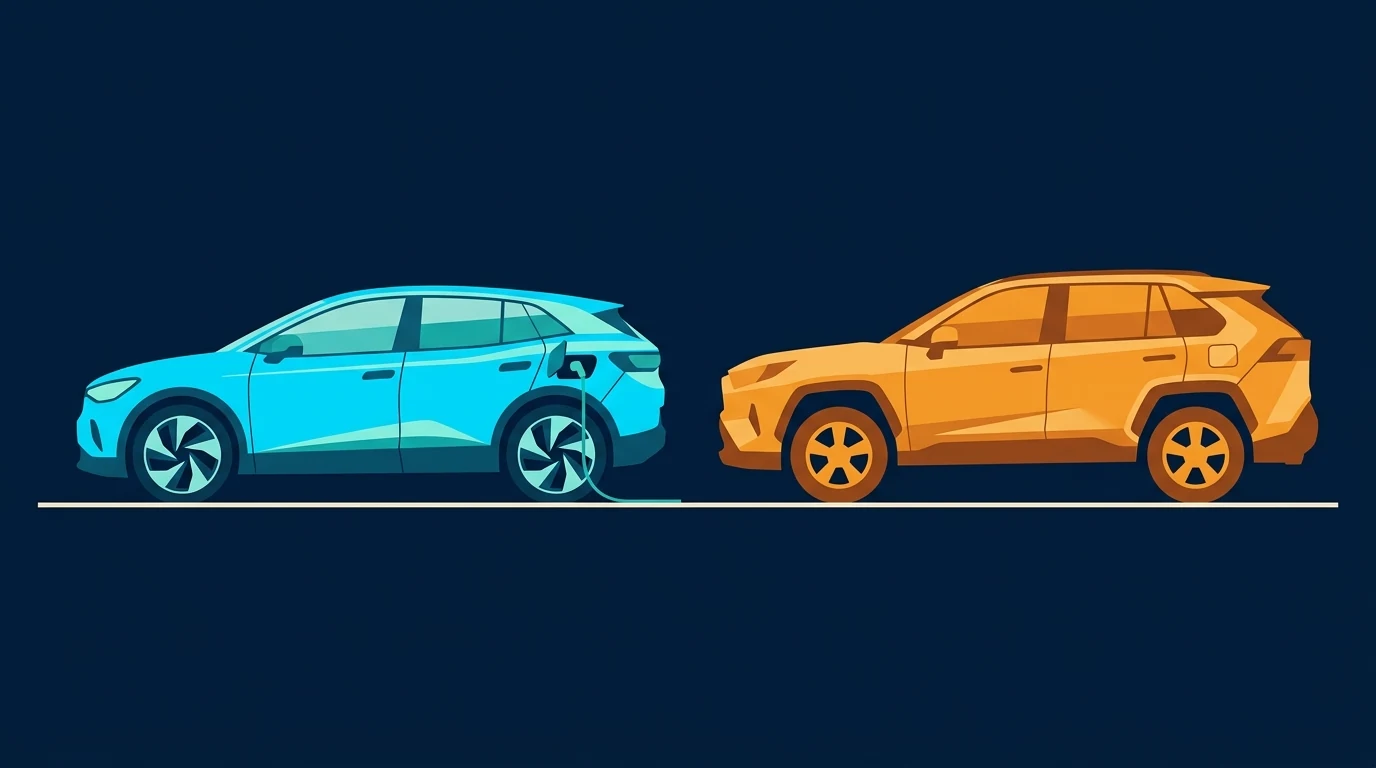
The 2026 Honda Prologue is cheaper to fuel than a CR-V Hybrid in 50 of the 51 jurisdictions we model, and it still makes poor sense to buy one to keep. Even after Honda took $7,500 off the price in April, the Prologue costs about $5,000 more than a comparable CR-V Hybrid. Home charging only earns that back within five years in Nevada, Washington, Idaho, Utah and Oregon. In July Honda confirmed that the 2026 Prologue is the last one, so anyone who buys it is also betting on the used price of a discontinued EV.
That leaves a short answer for most people choosing between the two at a Honda dealer: lease the Prologue or buy the CR-V Hybrid. The rest of this post shows the math behind that, state by state.
Two Things Changed in 2026
Most Prologue vs CR-V comparisons online were written before either change, and both of them matter. The first was price. The federal EV tax credit ended for cars bought after September 30, 2025, and sales fell. On April 1, 2026, Honda cut the Prologue's price by $7,500 on every trim, which in effect built the old credit into the sticker. The second change came in mid-July, when Honda confirmed that production ends after the 2026 model year. The Prologue is built for Honda by GM, on the same Ultium battery platform as the Chevrolet Blazer EV and Equinox EV. Remaining cars are expected to sell into early 2027.
The price cut moved the Prologue into CR-V Hybrid territory for the first time. The discontinuation is the reason the price gap alone doesn't settle it.
The Sticker Gap Is Now About $5,000
Matched by drivetrain, the cheapest Prologue costs $4,370 to $4,970 more than the cheapest CR-V Hybrid. The prices below are Honda's MSRPs including destination, taken from Honda's Prologue and CR-V pricing releases. Efficiency ratings are EPA combined figures from fueleconomy.gov.
| Model | Price w/ destination | EPA rating | Range |
|---|---|---|---|
| Prologue EX 2WD | $41,395 | 104 MPGe (33 kWh/100 mi) | 308 mi |
| Prologue EX AWD | $43,495 | 99 MPGe (34 kWh/100 mi) | 294 mi |
| Prologue Touring AWD | $48,495 | 99 MPGe | 294 mi |
| Prologue Elite AWD | $51,895 | 95 MPGe (35 kWh/100 mi) | 283 mi |
| CR-V Sport Hybrid 2WD | $37,025 | 40 MPG | — |
| CR-V Sport Hybrid AWD | $38,525 | 37 MPG | — |
| CR-V Sport-L Hybrid AWD | $41,620 | 37 MPG | — |
| CR-V EX AWD (gas, 1.5T) | $36,045 | 29 MPG | — |
Destination fees on both models have gone up by about $100 since those releases. That moves both prices about equally, so the gap stays the same. The fairer comparison is AWD against AWD: the Prologue EX AWD against the CR-V Sport Hybrid AWD, a gap of $4,970. The 2WD pair works out almost the same, at $4,370.
Fuel Savings Are Real but Slow
Charged at home, the Prologue saves about $600 a year over a CR-V Hybrid at national average prices. That means roughly eight years to cover the sticker gap. At $4.10 a gallon and $0.18 per kWh, 60,000 miles costs about $6,650 in gasoline for the CR-V Sport Hybrid AWD. The same miles cost about $3,670 in electricity for the Prologue EX AWD. That $2,980 saving over five years is less than two-thirds of the $4,970 gap.
The national average hides a wide spread, and that spread follows the gap between gas prices and electricity rates, not either price alone. We ran the AWD pair through each state's gas and electricity prices from the table behind our EV vs gas calculator (AAA gas, October 2026; EIA residential electricity), at 12,000 miles a year with home charging.
| State | 5-yr fuel saving with the Prologue | Years to cover the $4,970 gap |
|---|---|---|
| Nevada | $6,130 | 4.1 |
| Washington | $5,950 | 4.2 |
| Idaho | $5,380 | 4.6 |
| Utah | $5,290 | 4.7 |
| Oregon | $5,030 | 4.9 |
| Arizona | $4,560 | 5.4 |
| Illinois | $3,640 | 6.8 |
| California | $3,570 | 7.0 |
| Florida | $3,460 | 7.2 |
| Texas | $3,060 | 8.1 |
| Pennsylvania | $2,980 | 8.3 |
| Ohio | $2,480 | 10.0 |
| New Jersey | $2,090 | 11.9 |
| New York | $1,250 | 19.9 |
| Massachusetts | $910 | 27.2 |
| Hawaii | −$330 (hybrid cheaper) | never |
Only five states clear the gap within five years. Washington and Nevada get there because gas costs nearly $5.50 a gallon there while home electricity costs about 14 cents a kWh. California has the most expensive gas in the country and still takes seven years, because its electricity is expensive too. In New York and most of New England, a 37 MPG hybrid comes within a few hundred dollars a year of the EV, and in Hawaii the hybrid is cheaper to run. This is the same pattern we found in when hybrids beat EVs on cost. A good hybrid is a much harder target for an EV than a regular gas car.
Against the gas-only CR-V EX AWD (29 MPG), the Prologue looks better on fuel: about $5,000 saved over five years at national prices. The price gap is bigger too, $7,450, so the payback still lands at seven years or more in most states.
Want the payback for your state, gas price and mileage? Enter your own numbers.
Open the Free CalculatorWhy the Discontinuation Points to a Lease
A lease turns the biggest unknown in this comparison into someone else's problem. When you buy a car, your real cost is the purchase price minus what the car is worth when you sell it. Nobody knows yet how used buyers will price a Prologue once Honda has stopped making it, and EV resale values were already weak before Honda's announcement. If you plan to keep the car five years or more, that unknown could easily be bigger than the fuel savings in the table above.
A lease sets the car's end value in the contract on day one, so if used Prologue prices fall, Honda's finance arm takes the loss and you don't. Honda's national offers listed through November 2 include a 36-month Prologue EX AWD lease at $309 a month with $4,599 due at signing, or about $15,700 over three years before taxes and fees. There is also a $2,000 loyalty or conquest bonus for current Honda owners and owners of many rival brands, which lowers the monthly payment further. Buyers who finance get 0.99% APR for up to 60 months, but there is no cash rebate on a straight purchase. These offers change monthly and vary by region, so check your local dealer before you count on them. Our state EV incentive pages list the state rebates that can stack on top.
The CR-V Hybrid has the opposite profile. It is Honda's best-selling model, it has a long resale history, and Honda is putting more into hybrids. If you plan to own the car for eight or ten years, the CR-V Hybrid is the lower-risk choice in almost every state.
What Breaks the Prologue Math: No Home Charger
Every number above assumes you charge at home. Without that, the Prologue costs more to fuel than the CR-V Hybrid. At a public fast charger priced around $0.40 per kWh, the Prologue EX AWD costs about 13.6 cents a mile. The CR-V Sport Hybrid AWD costs about 11.1 cents a mile at $4.10 gas. If you live in an apartment or rely on public charging, read whether an EV works without home charging first. If you own a home, see whether a Level 2 charger is worth it at your mileage. You can also check your own per-mile cost with the EV cost per mile calculator.
Which One to Get
Lease the Prologue if you can charge at home, drive a normal amount, and like the idea of an EV for three years without worrying about what it's worth afterward. It makes the most sense in the West, where electricity is cheap and gas is not.
Buy the CR-V Hybrid if you keep cars a long time, live in the Northeast or Hawaii, or can't charge at home. Its fuel costs are close enough to the Prologue's in most of the country that the $5,000 lower price wins. If you're also considering a Tesla, our Model Y vs CR-V comparison runs the same math. For the Prologue's GM sibling against the same Honda, see Equinox EV vs CR-V.
Buy a Prologue outright only in the five states where fuel savings cover the gap within five years, and only if you get a real discount off the $43,495 sticker.
Frequently Asked Questions
Is the Honda Prologue being discontinued?
Yes. Honda confirmed in July 2026 that Prologue production ends after the 2026 model year. Remaining 2026 cars are expected to keep selling into early 2027.
How much did Honda cut the Prologue's price?
$7,500 on every trim, effective April 1, 2026. The 2026 Prologue EX 2WD now starts at $39,900 before destination ($41,395 with the $1,495 destination fee in Honda's April release).
Is the Prologue cheaper to run than a CR-V Hybrid?
With home charging, yes in 50 of 51 jurisdictions: about $3,000 cheaper over five years at national average prices, and $5,000 to $6,000 cheaper in the Pacific Northwest and Mountain West. Hawaii is the exception, where the hybrid is cheaper. Using public fast chargers, the CR-V Hybrid is cheaper almost everywhere.
Should I buy or lease a Prologue?
For most buyers, lease. A lease fixes the car's end value, so the risk of falling used prices after the discontinuation stays with Honda's finance arm. Buying makes sense mainly in the few states where fuel savings repay the price gap within five years.
Sources and method. Prices: Honda Newsroom pricing releases for the 2026 Prologue (April 1, 2026) and 2026 CR-V, MSRP including destination. Efficiency: EPA combined ratings via fueleconomy.gov; Prologue electricity use from EPA kWh/100 mi. Discontinuation and price cut: MotorTrend, Car and Driver. State gas (AAA, October 2026) and residential electricity (EIA) prices come from our calculator's table; national baseline $4.10/gal and $0.18/kWh. Assumes 12,000 miles a year and home charging. Fuel costs only: insurance, maintenance and depreciation are not included. Lease and APR offers are Honda national offers as listed through November 2, 2026 and vary by region. Prices as of October 15, 2026.